Quick Takeaways:
- Fatty liver, aka metabolic dysfunction-associated steatotic liver disease (MASLD), is highly reversible in its earlier stages. Liver fat, inflammation, and even early fibrosis can improve with the right interventions.
- MASLD is not an isolated liver problem. It is a metabolic warning signal closely tied to insulin resistance, visceral fat, prediabetes, cardiovascular disease, and other drivers of chronic disease.
- Weight loss is the single most important intervention, when clinically appropriate. A 3% to 5% reduction in body weight can reduce liver fat, 7% to 10% can meaningfully reduce inflammation, and 10% or more offers the best chance of improving early fibrosis.
- Mediterranean-style eating, regular exercise, and reducing sugar-sweetened beverages can improve liver health independent of weight loss.
- No supplement or detox product has been proven to reverse MASLD.
- At Personal Health MD, we treat fatty liver as what it is: a metabolic problem that requires a full evaluation of glucose, insulin sensitivity, lipids, blood pressure, and body composition, not a one-line instruction to lose weight.
Can Fatty Liver Actually Be Reversed?
Yes! And this is one of those areas in medicine where I get to deliver genuinely good news.
Many people hear the words fatty liver and assume they’ve been diagnosed with permanent liver damage. Fortunately, that’s often not the case. In its early stages, fatty liver disease is remarkably reversible, sometimes within months.
Fat accumulates in liver cells when the body is struggling to manage its energy stores effectively. Over time, this accumulation can trigger inflammation and eventually fibrosis, or scarring. If the process continues unchecked, some patients progress to advanced liver disease, including cirrhosis.
But there’s an important distinction between these stages:
- Liver fat can often be substantially reduced, sometimes quite rapidly.
- Inflammation can improve as we address the underlying metabolic dysfunction.
- Early fibrosis can regress, although this generally takes longer.
Advanced fibrosis and cirrhosis are more difficult to reverse, although improvement is sometimes possible.
The takeaway? The earlier we identify fatty liver disease, the greater our opportunity to reverse it and prevent long-term complications.
Why Fatty Liver Matters More Than Most People Realize
As a primary care physician specializing in lifestyle and preventive medicine, I think of fatty liver not as an isolated liver problem, but as an early warning sign of metabolic dysfunction and an opportunity to help patients improve their overall health.
The condition is now more commonly called metabolic dysfunction-associated steatotic liver disease, or MASLD (formerly known as nonalcoholic fatty liver disease, or NAFLD).
MASLD is closely associated with insulin resistance, excess visceral fat, prediabetes and type 2 diabetes, elevated triglycerides, hypertension, and cardiovascular disease.
In fact, cardiovascular disease, not liver failure, is the leading cause of death among people with MASLD.
Identifying MASLD in a patient thus prompts me to look at the bigger picture.
How is the patient managing their blood sugar? What do their triglycerides and other lipid markers look like? Is their blood pressure elevated? Are they accumulating visceral fat, even if their overall weight is relatively normal?
Fatty liver may be our first visible clue that something in the metabolic system needs attention. And that’s an opportunity worth taking seriously.
How Fatty Liver Is Found
Most people with early-stage fatty liver disease feel perfectly well. It’s frequently discovered incidentally, either through routine blood work or imaging performed for another reason.
Sometimes elevated liver enzymes provide the first clue. But normal liver enzymes do not rule out fatty liver disease, or even significant fibrosis.
When MASLD is suspected, we start by reviewing the patient’s metabolic risk factors, alcohol intake, medications, and other potential causes of liver disease.
We also assess the likelihood of liver fibrosis. One useful starting point is the FIB-4 score, a simple calculation based on age, liver enzymes, and platelet count. Depending on the results and the patient’s risk factors, we may recommend additional testing, such as a FibroScan, which measures liver stiffness and estimates liver fat.
We’re not simply confirming the presence of fat. We’re determining whether there’s evidence of liver injury or scarring and how aggressively we need to intervene.
What Actually Moves the Needle
Not surprisingly, the most effective interventions for reversing fatty liver mirror what we do for metabolic and cardiovascular health.
Weight Loss for Fatty Liver
For patients carrying excess body fat, sustained weight loss is one of the most effective treatments for MASLD.
And the amount required to make a difference may be smaller than you think:
- 3–5% weight loss is often enough to produce measurable reductions in liver fat.
- 7–10% weight loss provides even greater improvements in liver fat and concomitantly reduces inflammation.
- 10% or more offers the greatest odds of improving established fibrosis when scarring is present.
For someone weighing 180 pounds, even losing nine pounds may produce meaningful benefits.
Of course, not everyone with fatty liver is overweight. MASLD also occurs in people with a normal body mass index, particularly when visceral fat and insulin resistance are present. In these patients, improving body composition and metabolic health may be more important than losing weight.
Diet for Fatty Liver
No single magic diet exists for fatty liver disease, but the evidence strongly favors a Mediterranean-style eating pattern.
That means emphasizing vegetables, fruits, beans, lentils, whole grains, nuts, seeds, olive oil, and other minimally processed foods, along with adequate protein from plant or animal sources.
Equally important is reducing refined carbohydrates, added sugars, ultra-processed foods, and excess saturated fat.
One particularly effective change is eliminating sugar-sweetened beverages, including soda, sweetened teas, and fruit juice. These drinks deliver substantial amounts of sugar without the fiber and nutritional benefits of whole fruit.
And please be aware that a juice cleanse is not a liver detox. In fact, drinking large quantities of fruit juice may work against the very metabolic improvements we’re trying to achieve.
The goal isn’t a restrictive diet or a temporary cleanse. It’s an enjoyable, sustainable way of eating that supports long-term metabolic health.
Exercise for Fatty Liver
Exercise deserves particular attention because it can reduce liver fat even without weight loss.
Aerobic activity improves insulin sensitivity and helps the body use fat more efficiently. Resistance training builds and preserves muscle, an important site of glucose disposal and a powerful contributor to metabolic health.
I generally recommend working toward:
- At least 150 minutes per week of moderate-intensity aerobic activity (aka “Zone 2” training), with additional benefits up to 300 minutes per week.
- Two or more sessions of resistance training each week.
Walking, cycling, swimming, hiking, and other activities all count. Patients starting from a sedentary baseline don’t need to do everything at once.
Even relatively modest increases in activity can begin improving metabolic health.
Alcohol Abstinence for Fatty Liver
Alcohol deserves an individualized conversation.
MASLD is driven primarily by metabolic dysfunction, but alcohol can compound liver injury, particularly when inflammation or fibrosis is already present. For patients with significant fibrosis or cirrhosis, abstinence is recommended. For others, reducing or avoiding alcohol is a sensible part of treatment, especially while we’re evaluating liver health and monitoring improvement.
And while red wine has historically been associated with the Mediterranean diet, there’s no health-driven reason to start drinking it if you don’t already drink.
Medications for Fatty Liver
Lifestyle interventions remain foundational, but medications can play an important role, particularly for patients with obesity, type 2 diabetes, or more advanced liver disease.
GLP-1-based medications have been particularly encouraging. By promoting weight loss, improving metabolic function, and reducing inflammation, these treatments can substantially reduce liver fat.
Semaglutide (Wegovy) has also received FDA approval for adults with metabolic dysfunction-associated steatohepatitis (MASH), the inflammatory form of MASLD, who have moderate-to-advanced fibrosis but not cirrhosis. Tirzepatide (Zepbound) has demonstrated similarly promising results in ongoing clinical trials.
Other liver-directed treatments may be appropriate for selected patients with more advanced disease, generally in consultation with a liver specialist.
One additional point worth emphasizing: Statins are generally safe in patients with MASLD. A fatty liver diagnosis is not, by itself, a reason to stop cholesterol-lowering treatment. Given the elevated cardiovascular risk associated with MASLD, managing cholesterol and other cardiovascular risk factors is especially important.
Supplements and Detox Products for Fatty Liver
I wish I could say there’s a supplement that reliably reverses fatty liver disease. There isn’t.
The liver already performs an extraordinary range of detoxification and metabolic functions. It doesn’t need to be “cleansed.” It needs a healthier metabolic environment to do its job properly.
No over-the-counter liver detox product has been convincingly shown to reverse MASLD, and some supplements marketed for liver health can actually cause liver injury.
If you’re deciding between spending $100 a month on liver detox supplements and investing in healthier food, an exercise program, or a gym membership, I’d strongly encourage the latter.
What a Typical Clinical Trajectory for Fatty Liver Looks Like
Here’s a scenario I commonly encounter.
A patient feels well but has mildly elevated liver enzymes or an incidental finding of fatty liver on abdominal imaging. A closer look reveals a few additional metabolic concerns: perhaps fasting glucose is creeping upward, triglycerides are elevated, blood pressure is borderline, or body composition testing reveals more visceral fat than expected.
None of these findings alone may seem particularly alarming. Together, however, they tell a story.
We begin by assessing liver fibrosis risk and identifying the underlying metabolic drivers. Then we develop a plan incorporating nutrition, aerobic exercise, resistance training, sleep, and weight management when appropriate. For some patients, medications may also be helpful.
Over the following months, we often see meaningful improvements.
Liver enzymes may decline. Blood glucose and triglycerides improve. Visceral fat decreases. Follow-up testing may show a substantial reduction or even resolution of liver fat.
Not everyone follows the same timeline, and improved liver enzymes don’t necessarily mean fibrosis has resolved. That’s why appropriate follow-up matters.
But what I find most rewarding is that we’re not simply treating a fatty liver. We’re improving the entire person’s metabolic health.
The same changes that benefit the liver can also reduce the risk of type 2 diabetes, cardiovascular disease, and other chronic conditions. That’s a pretty remarkable return on investment.
The First 30 Days After a Fatty Liver Diagnosis
When a patient comes to Personal Health MD with a new diagnosis of fatty liver, our first priority is to understand what’s driving it and whether there’s evidence of significant liver damage.
We review alcohol exposure, medications, medical history, and laboratory findings. We calculate a FIB-4 score and arrange additional testing, such as FibroScan, when indicated.
We also take a comprehensive look at metabolic health, including glucose regulation, lipid levels, blood pressure, weight, body composition, and cardiovascular risk.
From there, we develop a realistic plan.
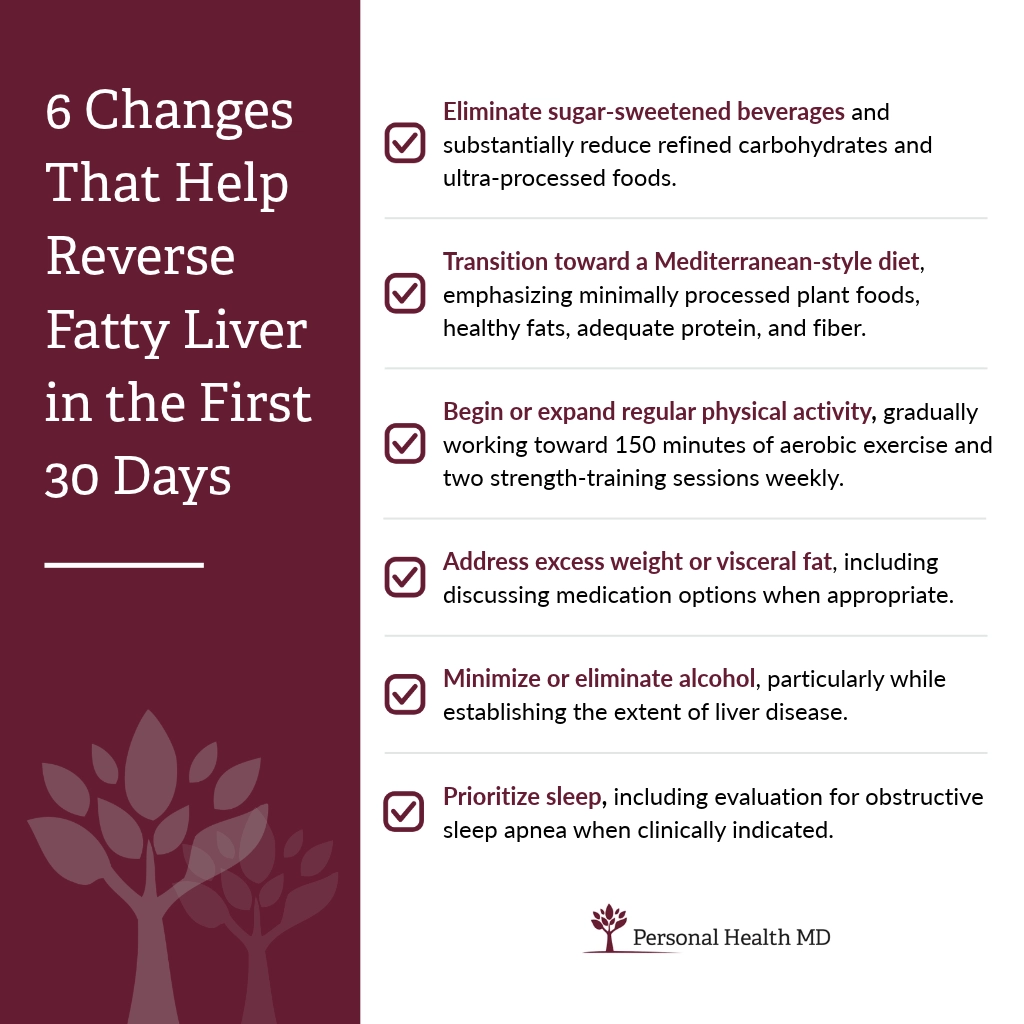
During the first month, I typically encourage patients to focus on several practical changes:
- Eliminate sugar-sweetened beverages and substantially reduce refined carbohydrates and ultra-processed foods.
- Transition toward a Mediterranean-style diet, emphasizing minimally processed plant foods, healthy fats, adequate protein, and fiber.
- Begin or expand regular physical activity, gradually working toward 150 minutes of aerobic exercise and two strength-training sessions weekly.
- Address excess weight or visceral fat, including discussing medication options when appropriate.
- Minimize or eliminate alcohol, particularly while establishing the extent of liver disease.
- Prioritize sleep, including evaluation for obstructive sleep apnea when clinically indicated.
Not every patient needs to make every change at once. We focus on the interventions most likely to make a difference for that individual, then build from there.
While 30 days is too soon to expect reversal of established fibrosis, it’s often enough time to start seeing meaningful improvements in metabolic health.
Fatty Liver: The Bottom Line
A fatty liver diagnosis isn’t a life sentence. It’s an opportunity.
For many patients, particularly those identified early, liver fat can be substantially reduced or even eliminated. And the benefits extend well beyond the liver.
By addressing the metabolic dysfunction driving MASLD, we can improve blood sugar regulation, body composition, cardiovascular health, and potentially long-term health outcomes.
That’s why I find this diagnosis encouraging rather than discouraging. It gives us something important to work on and, in many cases, a great chance to make a meaningful difference.
To schedule an appointment or learn more about our approach to preventive and lifestyle medicine, call (617) 585-1500 or visit Personal Health MD.