Quick Takeaways:
- Over-the-counter GLP-1 patches are not FDA approved and lack any established mechanism for weight loss. The GLP-1 peptide molecule is a large, bulky protein that is poorly absorbed through skin.
- Most products marketed as “GLP-1 patches” don’t contain semaglutide, tirzepatide, or any GLP-1 compound at all. Common ingredients like berberine, L-carnitine, and L-glutamine have no established role in weight loss, and L-glutamine actually promotes nutrient absorption, the opposite of how GLP-1 medications work.
- Over-the-counter GLP-1 patches are classified as dietary supplements, which means they don’t require FDA approval or clinical studies before being sold. The marketing can be misleading, and the labeling doesn’t always make it clear what you’re buying.
- FDA-approved oral GLP-1 medications now offer a legitimate needle-free option. The Wegovy pill (oral semaglutide) and Foundayo (orforglipron) have been shown in clinical trials to produce meaningful weight loss, and self-pay costs have dropped substantially.
- At Personal Health MD, we help patients evaluate GLP-1 options based on their full health history, symptoms, and goals, whether they’re considering an oral medication, an injectable, or wondering whether a GLP-1 is appropriate at all.
Do GLP-1 Patches Actually Work?
Advertisements for GLP-1 patches promise the results of a weekly injection without the needle or the cost. Prescription GLP-1 medications can run hundreds of dollars a month, and many patients prefer to avoid injections, so cheaper, needle-free alternatives attract real interest.
These patches are likely not effective, and the molecular science explains why. The GLP-1 molecule is a large peptide that is poorly absorbed through skin. Even if some GLP-1 peptide from a patch made it into the bloodstream, the benefits and side effects of GLP-1 medications are both systemic, driven by receptor activation throughout the body. A patch that produces no side effects is almost certainly producing no benefit.
Beyond the absorption problem, many products sold as “GLP-1 patches” don’t contain any GLP-1 compound at all.
Why a GLP-1 Molecule Can’t Get Through Your Skin
The GLP-1 peptide is a large, bulky protein molecule. It’s poorly absorbed through the skin for the same reason insulin can’t be delivered by a patch: the molecule is too large and bulky to cross the skin barrier in therapeutic amounts.
The comparison to nicotine patches or estradiol patches doesn’t hold. Estradiol is a fat-soluble steroid ring molecule, a very different structure from a protein. Fat-soluble molecules are more readily absorbed through skin cells; a large, bulky peptide like semaglutide or tirzepatide is not.
Even if some GLP-1 peptide were absorbed from a patch, it wouldn’t reduce the side effects that lead many patients to seek alternatives. GLP-1 receptors are distributed across multiple organ systems: in the pancreas, where they affect insulin function; in the brain, specifically the hypothalamus and the brainstem, where they influence satiety and fullness; along the vagus nerve, which connects the brain and the gut; and in the stomach, where they slow gastric emptying.
The benefits and side effects of GLP-1 medications are both systemic, driven by activation of these same receptors throughout the body. I tell my patients that when they feel full too quickly or experience nausea, that’s actually the medication’s intended mechanism working a bit too strongly. Nausea and early fullness often settle down by lowering the dose or spreading the starting dose out a little longer than seven days and then working back to it. For most patients, side effects resolve over time.
A patch that produces no side effects is almost certainly producing no benefit, because the molecule isn’t reaching the receptors that matter.
Researchers are investigating specialized transdermal delivery systems that could theoretically carry GLP-1 molecules through the skin barrier. A 2025 mouse study (Li et al., published in Biology) showed that a semaglutide-loaded transdermal system reduced body weight in mice, and a Phase 1 human clinical trial (VX-201) for a semaglutide microarray patch began recruiting in mid-2026. These are early-stage investigations, not commercial products, and they’re years from any potential clinical use.
What’s Actually in Over-the-Counter “GLP-1” Patches
Many of the patches available in stores and online don’t contain semaglutide, tirzepatide, or any GLP-1 peptide. They use the term “GLP-1” in their product name and packaging without including the actual molecule.
Using the term “GLP-1” in a product name while omitting the actual compound is misleading, even if the companies technically aren’t claiming the products contain the drug.
Common ingredients in these patches include berberine, L-carnitine, and L-glutamine:
- Berberine and L-glutamine can be used to help soothe the gastrointestinal tract and support gut microbiome balance, but they have no established role in weight loss.
- Berberine has been marketed as “Nature’s Ozempic,” a characterization that isn’t supported by clinical evidence.
- L-glutamine also speeds up absorption of molecules and nutrients in the small intestine. Nurses have given it for decades to patients who have had portions of their small bowel surgically removed to help the remaining intestine absorb more calories and nutrients. Including it in a weight loss product is counterproductive. GLP-1 medications work in part by slowing absorption; L-glutamine does the opposite.
- L-carnitine plays a role in fatty acid metabolism. Pooled clinical trial data show a statistically significant but clinically modest association with weight loss, averaging about 1 kg. The effect is inconsistent across studies and unrelated to GLP-1 receptor activation.
Because these products are classified as dietary supplements, no clinical studies are required before they can be sold. Any company can assemble a combination of ingredients, package it under a name that evokes a prescription medication, and put it on a shelf. That lack of regulatory oversight is one more reason to discuss any medication or supplement with your physician before buying it.
Legitimate Needle-Free and Lower-Cost Options
For patients who want to avoid injections or who are looking for a more affordable entry point, FDA-approved oral GLP-1 medications are now available.
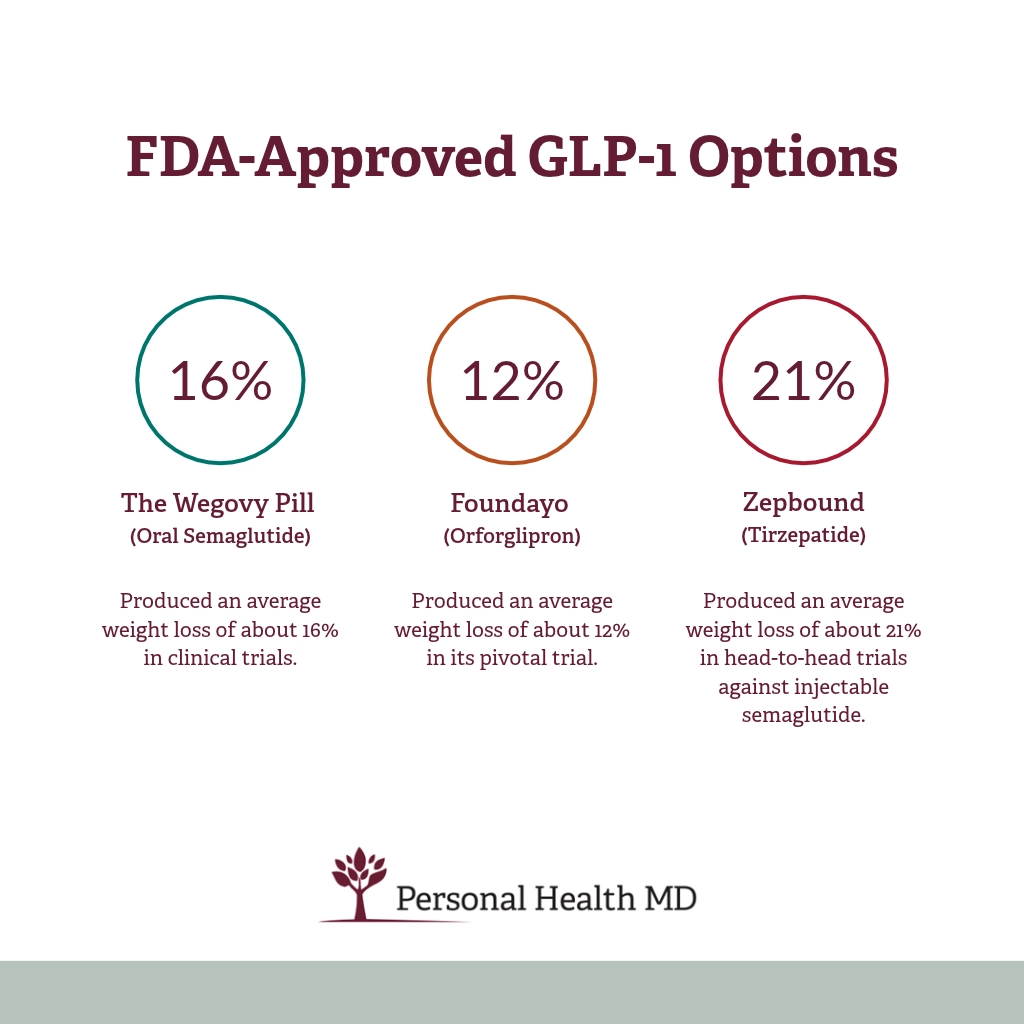
The Wegovy pill (oral semaglutide), approved by the FDA in December 2025, produced an average weight loss of about 16% in clinical trials, comparable to the injectable formulation. Foundayo (orforglipron, FDA approved as of April 2026) is a once-daily oral GLP-1 receptor agonist from Eli Lilly that produced an average weight loss of about 12% in its pivotal trial.
Unlike oral semaglutide, which is a peptide and requires an absorption enhancer, orforglipron is a small, non-peptide molecule. That molecular structure allows orforglipron to be taken at any time of day without food or water restrictions.
I’ve had clinical experience with these newer oral medications, and patients tolerate them well. Side effect profiles are similar to their injectable counterparts, because the mechanism of action is the same regardless of how the medication is delivered.
For patients who prefer or are better suited to an injectable, tirzepatide (Zepbound) produced an average weight loss of about 21% in head-to-head trials against injectable semaglutide and is available through LillyDirect.
Costs have come down substantially. Compared to a year ago, when these medications ran upward of $1,000 a month, oral GLP-1 pills now cost about $150 a month at lower doses and less than $300 a month at the highest dose. Injectable tirzepatide through LillyDirect starts at about $300 a month and goes up to about $450 at higher doses.
Medicare is also covering more GLP-1 medications for weight loss, which is expanding access further. Pricing in this category continues to shift, so a conversation with your physician or pharmacist can clarify the most current options.
When to Talk to Your Physician About GLP-1 Medications
If you’re considering a GLP-1 medication for weight management, talk to your physician before purchasing anything, whether it’s a prescription medication, an over-the-counter supplement, or a product you saw advertised online.
A physician can evaluate whether a GLP-1 medication is appropriate for you, help you choose the right formulation, and monitor your response over time. At Personal Health MD, we practice evidence-based medicine and take the time to discuss each patient’s full clinical picture before recommending a treatment approach. GLP-1 medications are effective tools, but they work best as part of an individualized plan that accounts for your medical history, other medications, and long-term health goals.
For patients whose weight management concerns intersect with broader metabolic risk, a cardiometabolic risk assessment can help clarify the full picture.
To schedule an appointment or learn more, call (617) 585-1500 or visit Personal Health MD’s website.