


Quick Takeaways:
- No single perimenopause test reliably confirms the transition the way HCG confirms pregnancy or A1c identifies diabetes. Hormone levels fluctuate too unpredictably during perimenopause for a single lab draw to be diagnostic.
- At-home perimenopause test kits measure follicle-stimulating hormone (FSH), which can vary dramatically from one day to the next. A high result may be informative, but a normal result doesn’t rule perimenopause out.
- Perimenopause is a clinical diagnosis. A thorough conversation about symptoms, menstrual changes, and quality of life tells a physician more than any single lab value.
- Lab testing plays an important role in ruling out conditions that can mimic perimenopause, including thyroid dysfunction, iron deficiency, vitamin D deficiency, anemia, and metabolic disruption.
- At Personal Health MD, perimenopause evaluation starts with a careful clinical conversation, supported by individualized lab testing and followed by ongoing monitoring and treatment adjustment.
Is There a Perimenopause Test?
Many women come into my office looking for a specific lab test that will confirm they’re entering perimenopause. They’ve seen at-home test kits marketed online, taken a quiz, or heard about hormone testing, and they expect a clear, binary answer.
Hormone testing isn’t the reliable indicator for perimenopause most women expect. Unlike pregnancy, where a single hormone (HCG) climbs predictably, or diabetes, where blood sugar and A1c provide consistent markers, the hormonal changes of perimenopause involve multiple hormones that fluctuate unpredictably.
The fluctuation itself is what makes a single perimenopause test unreliable. A woman can have her labs drawn on a Tuesday afternoon while her estrogen is rising, and the results could come back normal. The same draw a week later, or even a day later, could look entirely different.
Perimenopause is primarily a clinical diagnosis, not a laboratory diagnosis.
What At-Home Perimenopause Test Kits Actually Measure
The at-home perimenopause test kits widely available online typically measure follicle-stimulating hormone (FSH), a hormone produced by the anterior pituitary gland that helps regulate the ovaries.
FSH carries the same limitation as any single hormone draw during perimenopause: levels can vary dramatically from day to day. A high FSH result on an at-home test can be meaningful if it catches a genuine spike, but a normal result doesn’t rule perimenopause out. These kits provide a data point, not a diagnosis.
The more important limitation is what at-home kits don’t assess. When a woman presents with fatigue, brain fog, or mood changes, in-office lab testing can help rule out other conditions driving those symptoms: thyroid dysfunction, iron deficiency, vitamin deficiencies, metabolic disruption. An at-home FSH kit doesn’t screen for any of those.
A home FSH kit gives a woman one data point, but a clinical workup puts that data point in context alongside a broader evaluation.
How I Evaluate a Woman Who Suspects Perimenopause
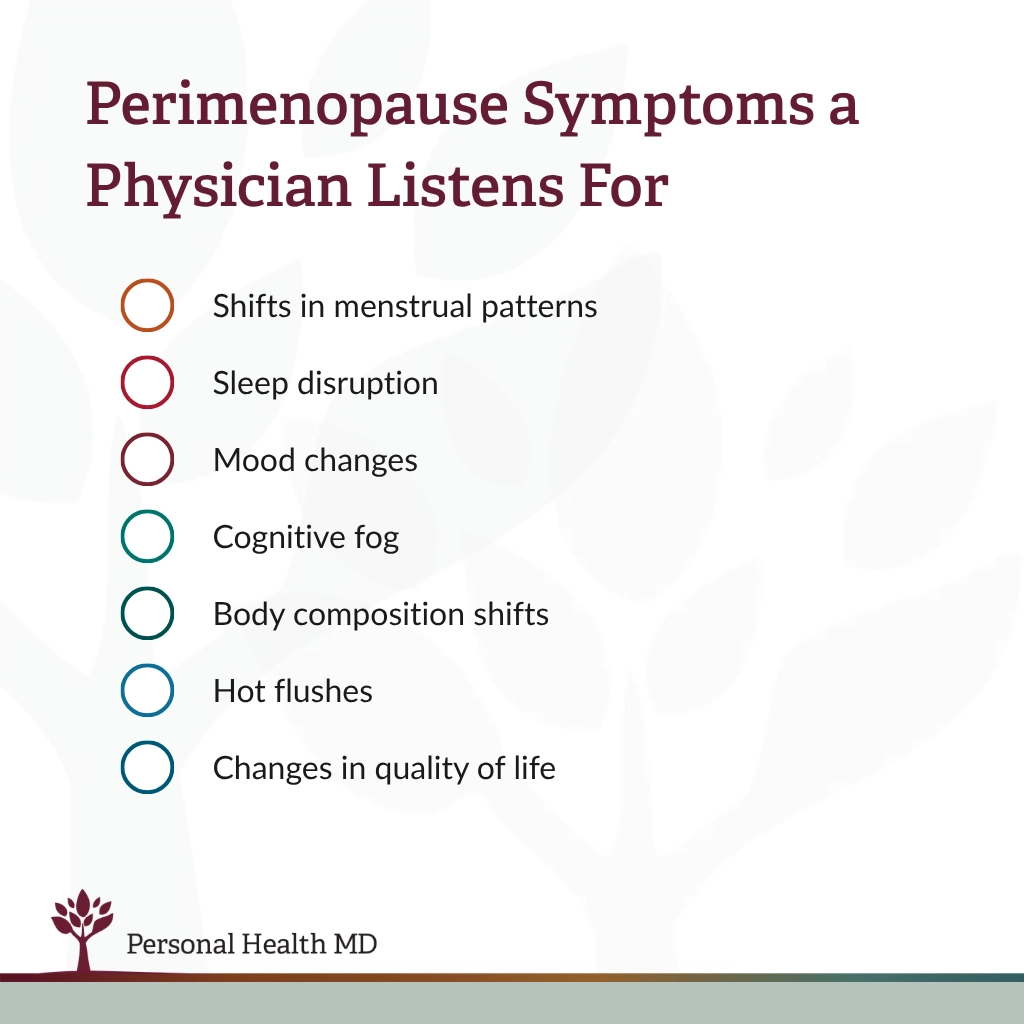
When I meet with a woman to discuss possible perimenopause, I’m not reaching for a single lab panel. I’m listening for the full constellation of symptoms: shifts in menstrual patterns, sleep disruption, mood changes, cognitive fog, body composition changes, hot flashes, changes in quality of life, and sometimes relational strain she can’t quite explain.
The presentation can be subtle. Many women describe perimenopause as “not feeling like myself,” without being able to pinpoint a specific symptom. Menopause clinicians sometimes call this the “NFLM” (Not Feeling Like Myself) presentation.
Taking the time to hear a woman’s full story is often the most informative part of any perimenopause evaluation. A single lab snapshot can’t capture what a careful clinical conversation can.
One biomarker I find increasingly useful as a marker of reproductive aging is anti-Mullerian hormone, or AMH. Unlike estrogen and FSH, which fluctuate unpredictably during perimenopause, AMH tends to decline progressively as ovarian function declines.

What AMH Can and Can’t Tell Us
AMH can help us understand where a woman may be along her reproductive lifespan, but it’s better at reflecting ovarian aging than diagnosing perimenopause itself. A low AMH can suggest the ovaries are aging, but AMH alone doesn’t tell me whether her current symptoms are caused by perimenopause, or whether she’s one year from menopause or seven.
AMH also doesn’t indicate which treatment would be most helpful. Even with this biomarker, the diagnosis still depends on symptoms, menstrual patterns, and the overall clinical picture.
When Lab Testing Reveals the Bigger Picture
Lab testing won’t confirm perimenopause, but it can uncover other conditions that produce the same symptoms.
When a woman comes in with fatigue, brain fog, and weight gain, I’m not only evaluating hormones. I’m drawing thyroid panels, iron studies, vitamin levels, and metabolic markers. Lab testing in a perimenopause workup often matters most for what it rules out.
One case from my practice illustrates what the broader workup can catch. A woman in her early 40s came in after extensive research on perimenopause, convinced that hormone therapy was the right path. She was experiencing fatigue, brain fog, weight gain, and that persistent sense of not feeling like herself.
We ran the broader panel alongside the hormonal workup and found significant iron deficiency and vitamin D deficiency, both of which had likely been building for years.
Once we addressed those deficiencies, many of her symptoms improved considerably.
She may have been entering perimenopause as well, and the hormonal shift may have been contributing. But hormones weren’t the whole story. Without the full workup, those deficiencies would likely have gone undetected and continued to worsen.
Do Baseline Hormone Levels Help Predict Perimenopause?
Some women in their late 30s or early 40s ask about establishing a hormonal baseline before symptoms start. The instinct is reasonable, but in practice, a pre-perimenopause hormone baseline isn’t particularly useful.
Once perimenopause begins, hormone levels shift so unpredictably that a carefully documented baseline becomes clinically irrelevant. What your estrogen or FSH looked like in your late 30s won’t inform your care once perimenopause is underway.
I’m often more interested in baseline cardiovascular and metabolic health than in pre-perimenopause hormone levels. Blood pressure, cholesterol, body composition, sleep quality, and lifestyle habits tell me more from a long-term health perspective than a hormone snapshot drawn before symptoms began.
When “Normal Labs” Don’t Tell the Full Story
Perimenopause is one of the most common clinical transitions in women’s health. An estimated 1.3 million women reach menopause in the United States each year, and at any given time, millions of women are navigating perimenopause or menopausal symptoms.
Despite that prevalence, many women are told “your labs look fine” and leave without a clear path forward, even when symptoms are affecting their daily lives. In a standard 15-minute visit, a physician often has time only for a single lab snapshot. A normal result during perimenopause can easily miss what’s actually happening.
As a Menopause Society Certified Practitioner, I have both the training and, within a concierge practice, the time to sit down with each woman and understand what’s happening individually. We develop a collaborative plan, drawing on the full clinical picture rather than a single set of labs.
That approach, having the time to listen, evaluate thoroughly, and follow up regularly, is what allows us to identify what’s driving symptoms and adjust treatment as needed.
Ready for a Clearer Picture of Your Health?
If you’re noticing changes in your periods, sleep, mood, energy, or ability to concentrate, and you’re wondering whether perimenopause could be contributing, a thorough evaluation can provide clarity and direction.
To schedule an appointment or learn more, visit our website or call (617) 585-1500.