


You open your lab results and spot a marker you’ve never seen before: Apolipoprotein B (ApoB).
If you’re told your ApoB number is outside the normal range, it may be unsettling, especially if the conversation topic quickly turns to heart disease risk.
My first piece of advice to patients when this is the case: Don’t panic. Instead, let’s start with a conversation about what this marker measures, what the normal range looks like, and why ApoB is such an important biomarker of cardiovascular health.
Apolipoprotein B Normal Range Explained
While ApoB testing has been around for some time, it’s only recently become more widely used. Although laboratories often report a “normal” reference range, ApoB targets are better thought of in terms of your personal health history than “normal versus abnormal” values.
In general, an ApoB below 90 mg/dL is a reasonable goal for people with low cardiovascular risk, while individuals at higher risk (e.g., those with diabetes, established cardiovascular disease, or a strong family history of heart disease) often benefit from substantially lower targets.
For example, imagine you’re a healthy 30-year-old with an ApoB of 115. Our recommendations for you would likely differ from those for someone with the same level who also has insulin resistance, chronic inflammation, or plaque already visible on a coronary artery calcium (CAC) scan.
Rather than serving as a diagnosis on its own, your ApoB level should be the start of a conversation with your doctor that considers your overall health, cardiovascular risk, and whether any additional evaluation is warranted.
Is ApoB the New LDL?
Around 39% of Massachusetts adults report having been told by a healthcare professional that they have high cholesterol. Because this estimate relies on self-report and includes only people who have been screened and informed of their results, it is almost certainly an underestimate.
Traditionally, to reduce cardiovascular risk, these adults have been encouraged to monitor their low-density lipoprotein cholesterol (LDL-C). But while LDL-C remains an important marker, recent guidelines increasingly recognize ApoB as a more accurate measure of risk.
This guideline shift is a result of what LDL-C measures, or more precisely, what it does not measure.
LDL is just one of several atherogenic particles in the bloodstream, along with “very low-density lipoprotein” (VLDL) and “intermediate-density lipoprotein” (IDL) cholesterol.
Thus, even when LDL-C appears normal, VLDL and IDL cholesterol can still be elevated. And because a standard lipid panel only reports LDL-C, it captures only part of your cardiovascular risk. ApoB can identify that discrepancy.
Cholesterol Load
LDL-C simply looks at the total mass, or volume, of atherogenic cholesterol in your system. ApoB tells a more complex story.
This is because every particle capable of contributing to plaque buildup is “tagged” with a single ApoB molecule. Thus, ApoB provides an estimate of the total number of atherogenic particles in the bloodstream. And according to recent research, the count of these potentially harmful particles is a more reliable predictor of cardiovascular risk than total cholesterol volume.
Think of cholesterol as cargo moving through your bloodstream on a highway of trucks. The same cholesterol cargo could be carried by just a few fully loaded trucks or spread out across many partially filled trucks.
Regardless of the total cargo volume in each truck, the more trucks you have on the road, the more crowded the highway gets. More traffic means more slowdowns, blockages, or even crashes. In your body, these “traffic jams” can manifest as plaque buildup, increasing your cardiovascular risk.
Studies suggest that a substantial proportion of people with normal LDL-C levels actually have elevated ApoB levels. By measuring ApoB, clinicians can better identify hidden hazards and provide patients with a more accurate overall assessment of cardiovascular risk.
Taking a Holistic View
For patients whose lab work indicates an elevated ApoB, personalized medicine is especially important.
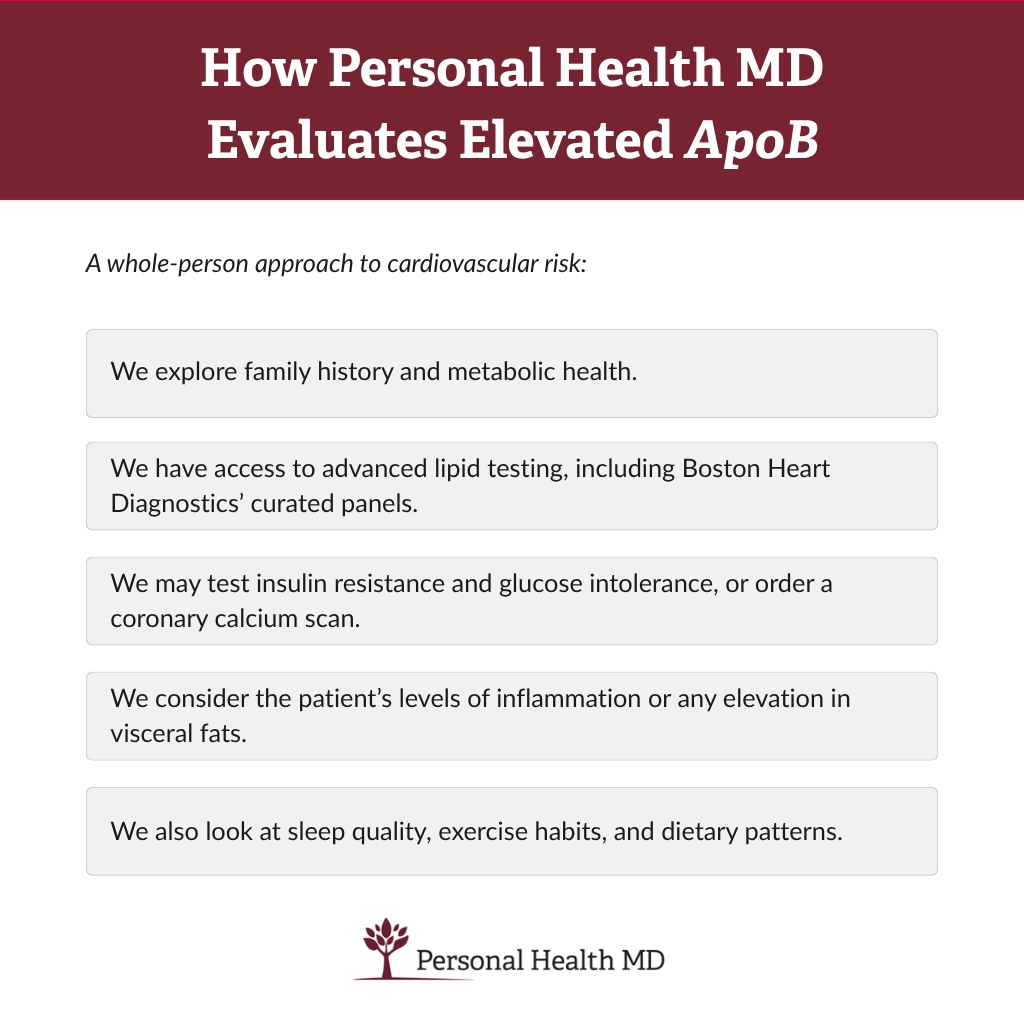
At Personal Health MD, our concierge physicians look holistically at the whole patient to identify potential areas of risk:
- We explore family history and metabolic health.
- We have access to advanced lipid testing, including Boston Heart Diagnostics’ curated panels.
- We may test insulin resistance and glucose intolerance, or order a coronary calcium scan.
- We consider the patient’s levels of inflammation or any elevation in visceral fats.
- We also look at sleep quality, exercise habits, and dietary patterns.
With this thorough snapshot, we tailor personal healthcare plans that improve each patient’s health one step at a time.
Not every individual with an elevated ApoB needs medication. Often, by working with us on their metabolic health and daily routine, a patient can significantly lower their ApoB without statins or other lipid-lowering aids.
High ApoB? Here’s What to Do
If you notice an elevated ApoB biomarker in your test results, there’s no need to panic. Instead, I encourage you to get curious. Bring your ApoB score to a member of our team. We’ll dive deeper, put it into context for you, and together, come up with an individualized plan.
This extra level of attention to the individual is a fundamental value of concierge care. We have the time and resources to carefully explore your background and craft a balanced approach for you.