Hormone replacement therapy covers a wide range of clinical situations. For women in perimenopause or menopause, it may mean estradiol, progesterone, and possibly low-dose testosterone as menopausal hormone therapies. For men experiencing the gradual decline of testosterone with age, it means testosterone replacement therapy (TRT).
At Personal Health MD, both fall under the same principle: hormone care that’s individualized and grounded in the full clinical picture rather than a single lab value.
Because testosterone replacement therapy for men is an area of growing patient interest, and one where the difference between careful clinical management and unsupervised prescribing is especially consequential, most of what follows addresses TRT directly. It also covers testosterone evaluation for women, which is an increasingly recognized part of hormone care.
Who Testosterone Replacement Therapy Is For
Men over the age of 40 may begin to experience andropause, the gradual decline of testosterone levels that increases with each decade of life. Unlike menopause, which involves a relatively abrupt hormonal shift, andropause is a slow drift downward that often goes unrecognized.
The symptoms can be subtle. A man may notice he isn’t building muscle the way he used to, or isn’t losing fat despite consistent exercise. Energy may drop, and the mindset shifts from “I can do this” to “I might do this.”
Erectile dysfunction or a loss of libido may develop. Loss of libido can have a physiologic component independent of relationship with added psychological factors.
Because these symptoms are broad and overlap with many other conditions, testosterone deficiency is frequently missed or attributed to other causes.
A second, less common group also benefits from TRT: younger men with true endocrine hypogonadism, in which the pituitary gland doesn’t adequately signal the testes to produce testosterone. After an endocrine evaluation confirms the diagnosis, TRT can be appropriate and, for some of these patients, genuinely transformative for energy and quality of life.
How We Evaluate Testosterone Levels
The decision to start testosterone replacement therapy at Personal Health MD is never based on a blood test alone.
We begin with a baseline testosterone profile that includes total testosterone, free testosterone, bioavailable testosterone, and sex hormone-binding globulin (SHBG). All four are important. A total testosterone level in isolation can be misleading.
But lab values don’t tell the whole story, because we can’t measure hormone receptors. Two men with the same testosterone level may have very different clinical pictures. One may have excellent receptors and no symptoms at a borderline-low level, functioning as though his testosterone were effectively higher. Another may have poor receptor sensitivity and significant symptoms at the same level.
That’s why we map the lab results against the full constellation of symptoms a patient describes. A man with a borderline-low level and pronounced symptoms of deficiency (difficulty with muscle formation, low energy, diminished libido) would likely benefit from a trial of treatment. A man with a borderline-low level and no symptoms typically doesn’t need it.
Using the total testosterone as the only deciding factor is too simplistic.
What Treatment Looks Like, From Start to Year One
Once we’ve evaluated a patient and determined TRT is appropriate, the next step is choosing a delivery system. Options include a weekly injection or a daily pill, gel, or cream. The choice depends on a patient’s preferences, lifestyle, and how their body responds.
After starting treatment, we check testosterone levels to confirm the therapy is working as anticipated. The target range is typically 500 to 900 ng/dL for total testosterone, with free and bioavailable testosterone also in the normal range. Too low offers no benefit, and too high introduces unnecessary risks.
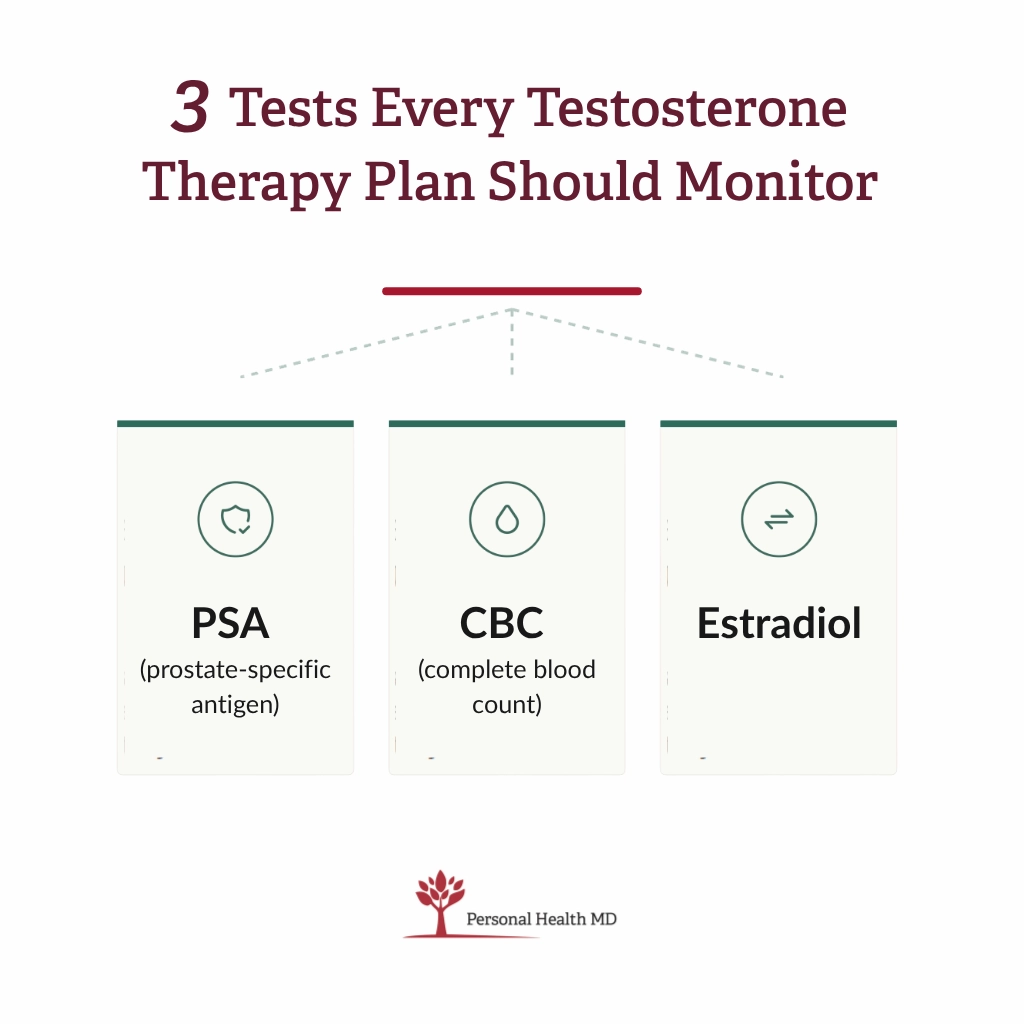
For the first year, we monitor at intervals of every two months until we establish a stable dosing schedule. After that, testing typically moves to two or three times a year. Three additional tests are part of every monitoring protocol:
- PSA (prostate-specific antigen): Studies show TRT doesn’t increase the risk of a new prostate cancer forming, but it may accelerate growth of an existing microscopic cancer. We check PSA twice a year because every man carries some baseline risk of prostate cancer, and we don’t want a patient on testosterone with an undetected malignancy.
- CBC (complete blood count): Testosterone can raise hemoglobin and hematocrit above the normal range. If levels climb too high, the intervention is blood donation to bring values back to normal.
- Estradiol: Testosterone converts to estradiol via the aromatase enzyme, and some men convert more than others. When conversion is excessive, a microdosed aromatase inhibitor such as anastrozole can slow the process and help the body retain more testosterone.
This monitoring isn’t optional. It’s what separates careful hormone management from the kind of unsupervised prescribing that puts patients at risk.
Why Unsupervised Hormone Therapy May Be Dangerous
Telehealth services can prescribe testosterone in about 15 minutes. What patients receive in that interaction is a prescription without adequate clinical context.
Any medication can be overdosed, and testosterone is no exception. I’ve seen patients arrive at our practice with testosterone levels exceeding 2,000 ng/dL after unsupervised prescriptions, more than double the upper end of the physiologic range. At those levels, the effects aren’t beneficial. Nothing good comes from overdosing on a hormone, and the consequences for health and personal relationships can be severe.
Testosterone therapy isn’t dangerous when managed well. But a hormone prescribed without baseline evaluation or clinical correlation to symptoms, and without ongoing monitoring of PSA, hematocrit, and estradiol, is a medication managed poorly. The consequences are predictable and preventable.

Testosterone for Women
Women also require healthy testosterone levels, in addition to estrogen and progesterone, and recognizing that has been one of the more important shifts in hormone medicine.
A normal female testosterone level is in the 20 to 45 ng/dL range and is physiologically important. When a woman presents with symptoms that overlap with perimenopause or menopause, including low energy, difficulty building muscle or losing fat, and diminished libido, we check a baseline testosterone profile in addition to evaluating her other hormonal status.
If testosterone is low, supplementation to a physiologic level may be appropriate. But this requires careful monitoring. Women can be overdosed on testosterone just as men can, and if levels rise into the hundreds, the effects can be significant, with untoward consequences for relationships.
Testosterone care for women isn’t a standalone treatment. It fits within a broader evaluation of menopausal hormone therapy and perimenopausal hormone needs.
What to Expect From Your First Visit
The symptoms of testosterone deficiency are broad and overlap with many other conditions. Low energy, reduced libido, difficulty with body composition, and mood changes can all have causes that have nothing to do with hormone levels.
That’s why the first conversation at Personal Health MD isn’t a quick questionnaire followed by a prescription. We evaluate the whole clinical picture: symptoms, medical history, lifestyle, relationship health, and any other conditions that might explain what a patient is experiencing. Only after that evaluation do we discuss whether hormone therapy is appropriate and, if so, what approach fits the individual patient.
This is personalized care, not a protocol. The doctor-patient relationship is what makes hormone care work well, and a 15-minute telehealth appointment can’t build that relationship.
Hormone Replacement Therapy at Personal Health MD
For the physicians at Personal Health MD, hormone care for both men and women is grounded in thorough evaluation and close follow-up. We follow current guidance from the Endocrine Society and integrate the research of Dr. Abraham Morgentaler, a leader in the field of testosterone replacement therapy, adjusting protocols to each patient’s clinical profile and response to therapy.
The concierge model gives us the time to do this carefully. Rather than prescribing a hormone and checking in six months later, we work with patients through the first year of treatment, adjusting doses and formulations as the monitoring data comes in. That iterative process is what good hormone care looks like.
If you’re experiencing symptoms that could be related to testosterone levels, or if you’ve been on unsupervised hormone therapy and want a more careful clinical approach, we’re here to help.
To schedule an appointment or learn more, call (617) 585-1500 or visit our website.