Quick Takeaways:
- A coronary artery calcium (CAC) score measures calcified plaque in the coronary arteries. It doesn’t detect soft, non-calcified plaque, which is often the higher-risk variety.
- In the CONFIRM study, 10% of individuals with a zero calcium score had measurable plaque on more detailed imaging, including some with blockages significant enough to cause a heart attack.
- Coronary CT angiography (CCTA), especially when enhanced with AI analysis, can identify both calcified and non-calcified plaque in the coronary arteries with a level of detail that approaches cardiac catheterization.
- Subclinical coronary artery disease, plaque that exists before symptoms develop, is now detectable. Earlier identification allows for more targeted and more aggressive prevention.
- At Personal Health MD, we use CCTA with Cleerly AI-enhanced analysis as our preferred tool for individualized cardiovascular risk assessment and heart attack prevention.
What a Calcium Score Measures, and What It Misses
Twentieth-century cardiology relied heavily on cholesterol measurement. Extensive research on lipid particles led to effective dietary guidelines and statin therapies that reduced heart attack risk significantly. But cholesterol levels alone don’t tell you whether plaque is actually forming in your coronary arteries.
Twenty-first-century cardiology offers more direct ways to evaluate the arteries themselves. The coronary artery calcium score (CAC) is one such tool. It’s a quick, low-dose CT scan that looks specifically at calcium deposits in the lining of the coronary arteries.
Calcium in the arterial wall is a marker for plaque, but it’s an indirect one. Not all plaque contains enough calcium to be visible on a CAC scan. Newer, softer plaque may contain no calcium at all, and this non-calcified plaque is often the higher-risk variety.
Plaque grows slowly over time, narrowing the coronary arteries. If it narrows enough, it can produce angina, chest pain, or shortness of breath. A complete blockage is a heart attack.
A zero calcium score can be reassuring, but it isn’t a guarantee of safety.
The CONFIRM Study: What a Zero Score Can Hide
A study known as CONFIRM examined over 10,000 people who underwent coronary artery calcium scoring. Among the 1,741 individuals who received a score of zero, more detailed imaging revealed their coronary health wasn’t as straightforward as the score suggested.
Of those with a zero calcium score, 10% had measurable plaque that the CAC scan couldn’t detect. Six percent had soft, non-calcified plaque that hadn’t yet developed a calcium signature. Four percent had calcified plaque that simply wasn’t picked up on the initial scan.
More concerning: 3.5% of these individuals had coronary blockages greater than 50%, and 1.4% had blockages exceeding 70%, a level that places a person at imminent risk of a cardiac event. A zero score, in other words, doesn’t rule out meaningful disease.
Beyond the Calcium Score: CCTA and AI-Enhanced Imaging
At Personal Health MD, I no longer use the CAC score as a first-line screening tool. I go directly to coronary CT angiography (CCTA), which examines the coronary arteries in much finer detail.
The challenge with CCTA has historically been interpretation. The imaging is in fine grayscale, and the human eye can struggle to distinguish degrees of narrowing. A typical reading might report a range of 19% to 49% narrowing in a given artery, which leaves a wide margin for clinical decision-making.
We use Cleerly, an AI-enhanced analysis platform that reads CCTA data with a level of precision approaching cardiac catheterization. Cleerly differentiates between calcified plaque and non-calcified soft plaque and produces a detailed readout of each coronary artery, including the location and composition of any plaque present. Cardiac catheterization itself is now rarely performed outside of pre-surgical assessment, which makes this degree of noninvasive detail especially valuable.
That level of detail has changed how I approach heart attack prevention. Rather than relying on population-level risk estimates based on cholesterol levels alone, I can see what’s actually happening in a specific patient’s coronary arteries and respond to it directly.
When a Normal Result Isn’t the Whole Story
One patient, a man in his mid-50s with a strong family history of heart disease, had been on a statin for 14 years and kept his LDL generally in the 70 to 80 range. He had a normal stress test with his cardiologist. No red flags.
But he wanted to know more. We performed a CCTA with AI-enhanced analysis, and it revealed a 64% blockage in the LAD, the left anterior descending artery sometimes called the widowmaker. That degree of disease would not have been found with conventional screening alone.
His cardiologist got him in and treated promptly. And the finding illustrates why I’ve moved beyond the calcium score: when the tools exist to identify subclinical coronary artery disease before symptoms develop, relying on less sensitive screening means accepting a blind spot.
Subclinical Coronary Artery Disease: Acting Before Symptoms Appear
The concept of subclinical coronary artery disease is central to where preventive cardiology is heading. Rather than waiting for chest pain, angina, or a cardiac event, we can now identify plaque in the coronary arteries before a patient knows it’s there.
When CCTA reveals early or moderate plaque, we can intervene more aggressively with evidence-based strategies. For patients with substantial plaque burden, I consider targeting an LDL below 55 mg/dL, a much sharper target than the older recommendation of less than 100. Research has shown that achieving an LDL below 55 can stabilize and even partially regress plaque, though it won’t eliminate it entirely.
For patients with lesser blockages, in the 10% to 20% range, the finding may lead to adjusting statin therapy or adding a PCSK9 inhibitor to lower LDL further. In either case, the clinical response is more precise because the imaging data is more precise.
I’ve also been able to detect and treat people with subclinical disease who had no symptoms and no conventional reason to investigate further. That early detection is the point.

Who Should Look Beyond a Calcium Score
CCTA for primary cardiovascular screening isn’t yet standard of care by insurance reimbursement guidelines. It’s a newer test, and it’s typically private pay, out of pocket. But the clinical value is substantial for the right patients.
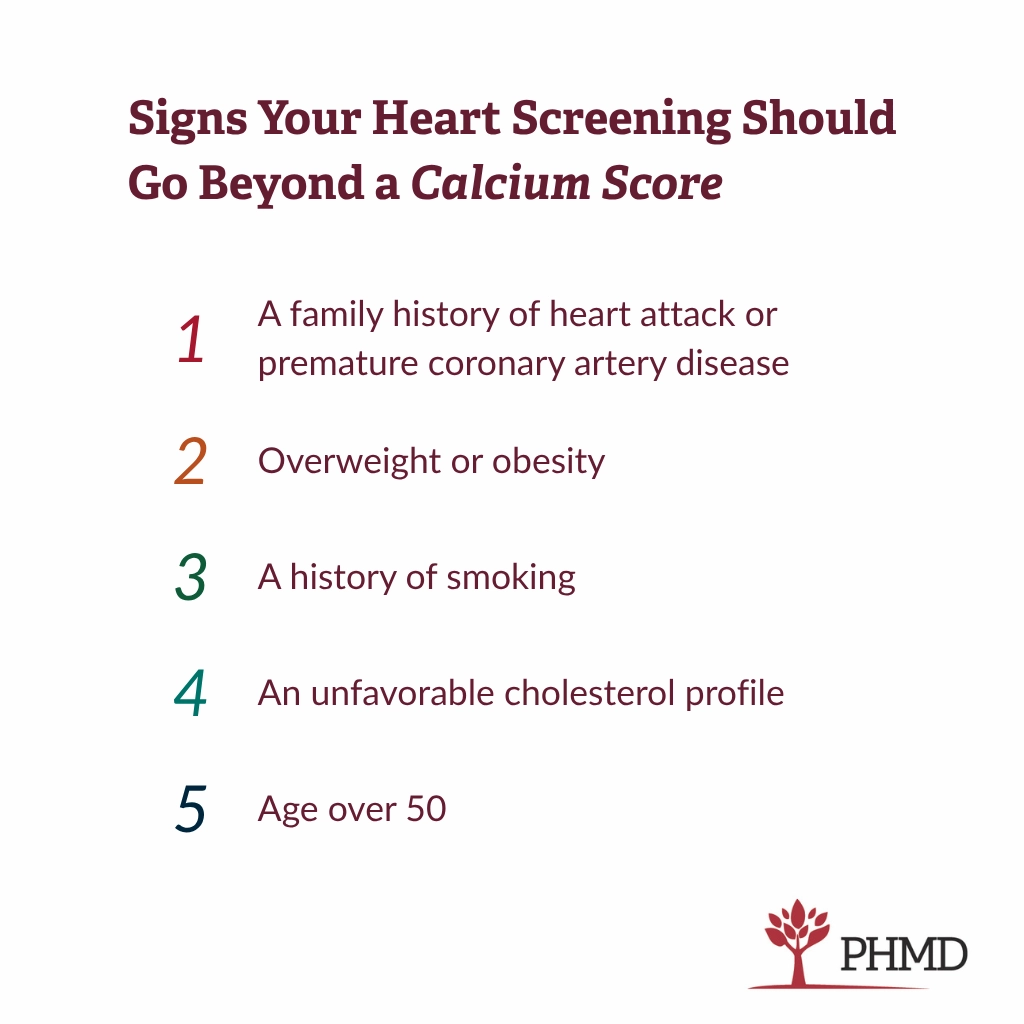
I recommend CCTA for anyone who wants to take a proactive approach to heart attack prevention, particularly those with:
- A family history of heart attack or premature coronary artery disease
- Overweight or obesity
- A history of smoking
- An unfavorable cholesterol profile
- Age over 50, though for patients with a strong family history or additional risk factors, I may recommend screening starting at age 40
The rationale for earlier screening in that 40-to-50 age group is clinical, not hypothetical. Heart attacks can and do occur in that decade. Among patients who have a heart attack between 40 and 50, the rate of sudden cardiac death is upward of 20%. Some never get a second chance to address their risk.
In a similar way that a baseline colonoscopy at age 45 screens for colon cancer, a baseline CCTA can screen for coronary artery disease at a stage when prevention is still possible.
Cardiovascular Risk Assessment at Personal Health MD
At Personal Health MD, cardiovascular prevention goes beyond standard lipid panels and population-based risk calculators. We use CCTA with Cleerly AI-enhanced analysis alongside detailed lipid testing and other biomarkers to build an individualized picture of each patient’s cardiometabolic health.
The goal isn’t to chase a single number but to understand what’s happening in your arteries and act on it early. For patients who’ve received a zero calcium score elsewhere and assume they’re in the clear, this evaluation may reveal coronary risk a calcium score can’t see.
If you’re holding a zero calcium score and wondering whether it tells the full story, or if you have a family history of heart disease and want to go beyond conventional screening, we can help you understand your actual risk.
To schedule an appointment or learn more, call (617) 585-1500 or visit our website.