


Quick Takeaways
- Perimenopause typically lasts about four to five years, although duration varies widely. Symptoms such as hot flashes may continue for years beyond the menopausal transition.
- Genetics influence the timing of menopause, but there is no precise way to predict an individual woman’s perimenopause timeline. Cancer treatment, ovarian surgery, smoking, and other health factors may also affect timing.
- Perimenopause is a normal biological transition, not a disease, but its symptoms can significantly affect sleep, mood, cognition, work, relationships, and quality of life.
- Effective treatments are available. Depending on a woman’s symptoms, medical history, and preferences, options may include menopausal hormone therapy, vaginal estrogen, hormonal contraception, and nonhormonal therapies.
- At Personal Health MD, we take the time to understand each woman’s symptoms, health history, and goals and develop an individualized approach to perimenopause and long-term health.
How Long Does Perimenopause Last?
Perimenopause is the transitional phase before menopause, when ovarian hormone production becomes increasingly variable. It typically lasts about four to five years, but there is considerable variation from woman to woman.
For many women, changes begin in their 40s, although symptoms can start earlier. And the symptoms we associate with perimenopause do not necessarily fit neatly within that four-to-five-year window. Hot flashes and night sweats, for example, may persist for many years.
More important than predicting exactly how long perimenopause will last is recognizing what is happening and deciding whether symptoms warrant treatment. Working with your physician to manage symptoms and protect long-term health can make this transition considerably easier.
Why the Perimenopause Timeline Varies
No two women move through perimenopause on exactly the same schedule.
Genetics play an important role in the timing of menopause, so knowing when your mother or sisters reached menopause can provide some context – but it can’t predict your own experience precisely.
Medical factors can also alter the timeline. Chemotherapy and other cancer treatments, ovarian surgery, and conditions or treatments that affect ovarian function may cause menopause to occur earlier or more abruptly.
And for many women, there simply isn’t a clear family history to rely on. Previous generations often didn’t talk openly about perimenopause, so patients may know when their mothers stopped having periods but little about the years of symptoms that preceded it.
The Stages of Perimenopause
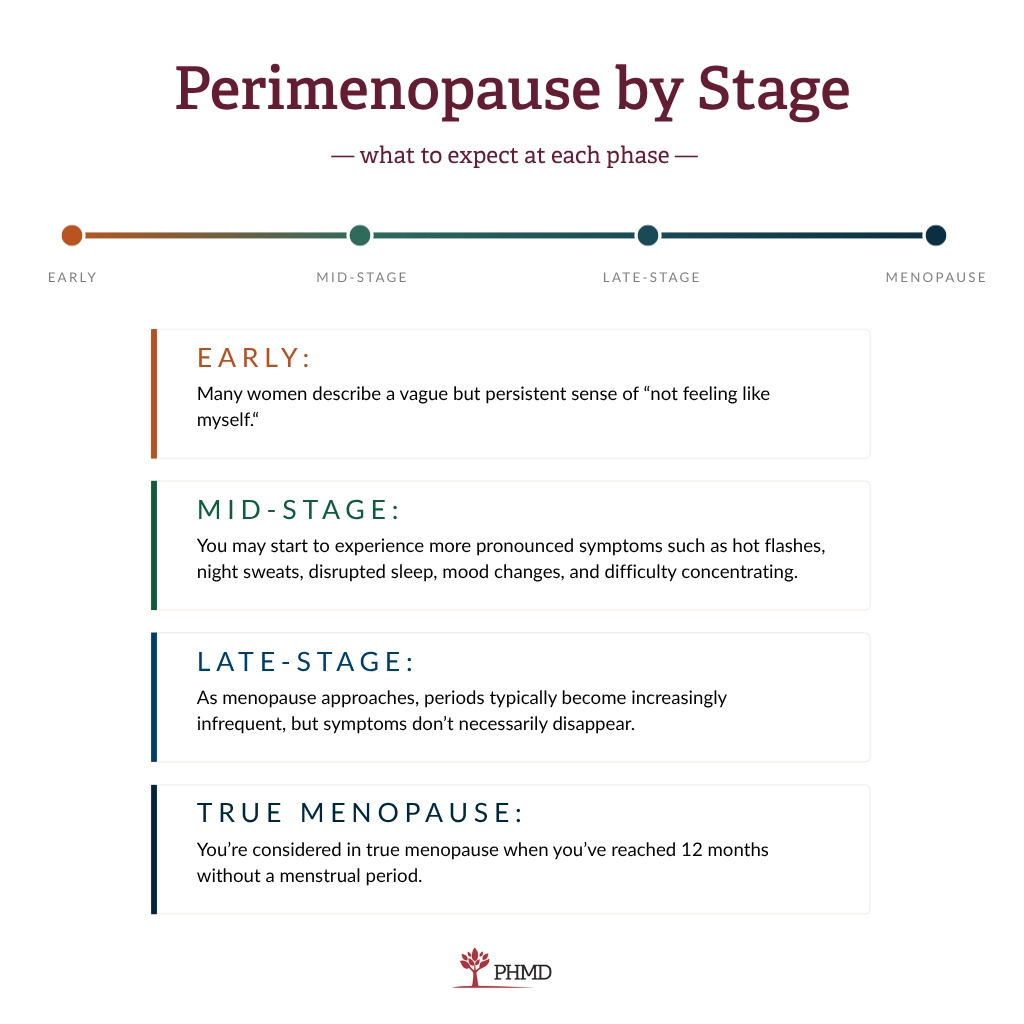
Perimenopause doesn’t arrive all at once. Hormonal changes occur over time, and symptoms typically evolve with them. Although every woman’s experience is different, the transition tends to follow a general progression.
Early Perimenopause
Early perimenopause can be surprisingly difficult to recognize.
Periods may still be fairly regular, but sleep, mood, concentration, body composition, and temperature regulation may begin to subtly change. Many women describe a vague but persistent sense of “not feeling like myself.”
Pregnancy is still possible during perimenopause, even when periods become irregular, so contraception remains an important part of the conversation when pregnancy is not desired.
Mid-Stage Perimenopause
As hormone fluctuations become more pronounced, symptoms may become more noticeable. Hot flashes, night sweats, disrupted sleep, mood changes, and difficulty concentrating can significantly affect quality of life.
For some women, these symptoms can be genuinely disabling. I have cared for women whose sleep disruption, sweating, or cognitive symptoms became severe enough to interfere with their ability to work.
Late-Stage Perimenopause
As menopause approaches, periods typically become increasingly infrequent, but symptoms don’t necessarily disappear. Some women improve; others continue to experience hot flashes, sleep disruption, or other symptoms well after their final menstrual period.
Menopause itself is defined retrospectively: 12 consecutive months without a menstrual period, assuming there is no other medical explanation.
It is common to go many months without a period and then have another cycle, which restarts the 12-month count.
Effective Treatment at Every Stage
For the past 25 years, these disruptive, potentially life-altering symptoms have largely been accepted as something a woman must simply endure. Prescriptions for hormone replacement, now called Menopausal Hormone Therapy (MHT), dropped abruptly by roughly 70% after the Women’s Health Initiative (WHI) halted its combined estrogen-plus-progestin trial on July 9, 2002 due to an increased risk of breast cancer, heart attacks, and strokes.
However, subsequent breakdowns of the WHI data showed that risks were significantly overestimated by studying older women (average age in their 60s and 70s) rather than those newly transitioning through menopause. Updated medical guidelines and the removal of generalized scare-labeling have clarified that earlier fears primarily applied to older populations. Additionally, while still not recommended for women with a history of hormone-sensitive cancers (like breast cancer), stroke, or active liver or heart disease, modern MHT favors transdermal options (patches, gels) over older oral horse-derived estrogens, which significantly lowers the risk of blood clots and stroke.
For appropriate patients, menopausal hormone therapy can be highly effective for hot flashes and night sweats and may also improve sleep and other symptoms related to the menopausal transition. Other hormonal and nonhormonal treatments are also available. The right choice depends on the individual woman’s symptoms, age, health history, risk factors, and goals.
I encourage my patients to understand what is changing in their bodies and to use this period as an opportunity to reassess their overall health. Four, five, or more years is a long time to live with poor sleep, frequent hot flashes, or symptoms that interfere with daily life.
Perimenopause is a normal biological transition, but that doesn’t mean women need to suffer through significant symptoms without treatment.
Fortunately, we have effective treatments. Options may include:
- Transdermal estradiol, delivered through the skin rather than taken orally and associated with a lower risk of venous thromboembolism than oral estrogen
- Micronized progesterone, such as Prometrium, for women with a uterus who use systemic estrogen, to protect the endometrium
- Vaginal estrogen or other local therapies for vaginal dryness, discomfort, or genitourinary symptoms
- A low-dose oral contraceptive for selected women who need both symptom management and contraception
- Nonhormonal therapies when hormone therapy isn’t desired or medically appropriate
Hormone therapy may also help prevent the bone loss associated with declining estrogen levels. Its potential benefits and risks beyond symptom treatment depend on a woman’s age, timing, medical history, and the specific therapy used.
Treatment should always be individualized, but these therapies can be safe and effective when prescribed appropriately.
Perimenopause Care at Personal Health MD
Perimenopause is often a clinical diagnosis, and “normal” laboratory results don’t mean a woman’s symptoms aren’t real or treatable.
Hormone levels can fluctuate dramatically during this transition, which is why a single blood test often doesn’t tell the whole story.
At Personal Health MD, I have the time to sit down with each patient, understand what has changed, consider other possible causes of her symptoms, and develop a treatment plan around her health history, symptoms, and goals.
The concierge model also gives us the flexibility to follow up and adjust treatment rather than simply prescribing something and waiting six months or a year to see whether it worked.
Perimenopause care is rarely one-size-fits-all. Sometimes the first approach works beautifully. Other times we may need to adjust the dose, formulation, or treatment until we find what works. At Personal Health MD, we take the time to learn each woman’s individual concerns, then thoughtfully and collaboratively develop an effective treatment plan.
This individualized approach to perimenopause care can have a profound impact on a woman’s experience during this life transition.
When to Talk to Your Physician
If you’re in your late 30s, 40s, or 50s and noticing changes in your periods, sleep, mood, temperature regulation, or ability to concentrate, it’s reasonable to ask whether perimenopause could be contributing.
Women with symptoms at younger ages should also talk with their physician rather than assuming the symptoms are simply stress or aging.
Fatigue, brain fog, sleep disturbance, and weight changes are not specific to perimenopause. Thyroid disease, anemia, sleep disorders, insulin resistance, medication effects, depression, and other conditions can produce overlapping symptoms.
That’s why good perimenopause care isn’t simply about prescribing hormones. It’s about listening carefully, considering the whole clinical picture, ruling out other explanations when appropriate, and then deciding together what treatment makes sense.
To schedule an appointment or learn more, call (617) 585-1500.